Author Archives: ASLE-UKI

Green Letters Special Issue – Call for Papers

Conflictual Entanglements: Negotiating the More-than-Human in Chinese Urban Spaces

Co-edited by Sara Landa and Matthias Schumann (Heidelberg University)

This special issue seeks to investigate the different ways in which the relationship between the human and the more-than-human have been negotiated and imagined in Chinese urban spaces from the middle of the nineteenth century until the present.

Throughout history, urban spaces have been characterized by a conflictual, contradictory, and uneven relationship between the human and the more-than-human inhabitants of the urban ecosystem (soils, vegetation, water bodies, microbes as well as nonhuman animals; cf. Grimm 2020, 5), what Karen Thornber (2011) refers to as “ecoambiguity.” Informed by modern concepts of planning and public health, cities around the world tried to eradicate undesired nonhuman species from cityscapes or marginalize them within strictly controlled boundaries, a process that picked up steam during the late nineteenth and early twentieth century (Biehler 2013) and contributed to the perception that cities were essentially anthropogenic or nature-less spaces (Brantz 2020). Yet, recent scholarship has questioned the characterization of urban spaces as the purview of human civilization and instead emphasized cities as spaces of multispecies interactions. Nonhuman animals remained crucial for the sustenance of many cities beyond the nineteenth century (Owens/Wolch 2017; McShane/Tarr 2007), while many species that were subject to marginalization campaigns continue to carve out their own “beastly spaces” beyond human control or have newly migrated to cities in recent decades to occupy new niches in the cityscape, often leading liminal existences in tension with humanly defined roles and perceptions (Philo/Wilbert 2005; Wischermann/Howell 2019; Gandy 2022). As such, nonhuman species are not only stakeholders in urban environments, they are co-producers of urban space, shaping the form and evolution of cities around the globe. To come to terms with the complexities of urban life, non-human beings therefore need to be reconsidered in their agential roles within multifaceted, tension-loaded dynamics of entanglements and “intra-actions” (Barad 2007) with human agencies and architectural environments (Bayes 2023). Moreover, distinct boundaries have come under scrutiny not only within urban spaces themselves. The borders and transitions between the perceived “strange other” (Schliephake 2015) of the man-made city versus its “natural” countryside surroundings likewise appear porous in the light of the flows of resources, mobilities of human and nonhuman species, and the following socioeconomic and ecological entanglements (Rademacher 2015).

Rapid processes of urbanization coupled with the effects of climate change, which are particularly felt in urban spaces, have put the role of the more-than-human within cities into even sharper relief. Recent approaches to city planning are aiming to reintegrate more-than-human species in the form of greenspaces or urban agriculture to improve resilience, biodiversity, and quality of life (Granzow/Lorenzen/Schumann 2025). Yet, while such approaches question the nature of cities as the purview of humans, paradoxes and challenges persist. Even though certain plant or animal species are reintroduced, others continue to be marginalized, usually based on narrow perceptions of human value (Wang 2023). Access to green spaces and the more-than-human, moreover, intersects with social, racial, and economic marginalization, wherefore ecologically diverse environments are often limited to those with the necessary means and standing (Gioielli 2025; Hartog 2025). These challenges have prompted a reconsideration of imaginations of urban spaces, which has been particularly forceful in literature and the arts. While earlier approaches of ecocriticism have long focused mainly on non-urban spaces, recent years have seen a shift towards depictions and imaginations of living spaces within cities and their surroundings (Buell/Heise/Thornber 2011). Fictional and non-fictional works try to give expression to the tension-loaded multispecies interactions in urban spaces, questioning and critiquing human dominance. So-called “ruderal literature,” for instance, imagines multispecies experiences in the remnants of overused spaces or at the margins of human-controlled spaces, such as old factory buildings or abandoned building projects (Kubin 2020; Reents 2020). At the same time, the experientiality and agency of non-human species often unsettles and redefines not only the spatiality of a story, but also its temporality; literary texts explore such tensions in clashes of the static and dynamic and in the confrontation of different temporalities (Bayes 2023, Møller-Olsen 2022) thereby becoming repositories of alternative cultural and historical memory (Schliephake 2016, Møller-Olsen 2022).

Turning its focus on China, this special issue wants to take up some of these more recent shifts of research interests in order to shed new light on discourses, developments, and imaginations of Chinese urban spaces from the middle of the nineteenth century until the present. The history of important urban centers—such as Shanghai or Beijing—has so far been largely studied from an anthroprocentric perspective; nonhuman actors have usually been ignored. This special issue seeks to correct this oversight and learn more about how multispecies interactions in Chinese urban spaces have shaped cities in the Sinophone world during a time period that saw complex historical, social, political, and cultural transformations.

Existing research seems to suggest that many Chinese cities experienced similarly conflicting developments during this period. Often spurred by the influence of newly introduced concepts of hygiene, public health, and urban planning, undesired species such as mosquitoes, rats, flies, or dogs were targeted in hygiene campaigns that were promoted by both foreign and Chinese authorities during the nineteenth and early twentieth century (Rogaski 2004; Nakajima 2018; Ying 2024). At the same time, selected animal and plant species were newly introduced into Chinese urban spaces in the context of new leisure activities (dog racing, gardening), the rise of pet keeping, the attempt to improve living conditions, or the introduction of highly curated spaces of multispecies interactions (such as zoos and public parks) (Zhang 2018; Zhang 2023; Zhu 2022). Shaped by their distinct colonial and semi-colonial conditions, recent research suggests that many Chinese cities served as “contact zones” in which different understandings of the nonhuman and its role in urban society could be negotiated (Poon 2019). Such processes remain little studied and this special issue wants to better understand how the specific social, political, and cultural setting of Chinese cities shaped multispecies interactions since the nineteenth century. This period saw rapid processes of economic development and urbanization that were accompanied by modernist discourses of a domination over nature (Shapiro 2001), but also more recent projects of eco-development (Xie et al. 2019) or architectural attempts to integrate existing lifeworlds with building projects (for example, by Chinese urban architects such as Pritzker laureate Liu Jiakun; Rolla 2025). How did these complex socio-political developments impact cities and their environment? What can we learn from approaches that trace the entangled experiences of humans and nonhumans in a rapidly changing world (Yin/Gao 2025)?

Taking yet another angle, the special issue wants to unravel how cities as experiential spaces have fed into literary and artistic works—and how these imaginations of urban spaces may have offered alternative “readings” of cities, contradicted ongoing developments or tried to prompt a reconsideration of the entanglements and agencies of the living beings in urban spaces. Recent research on Sinophone cities such as Taipeh or Hong Kong has shown how the more-than-human environments have compelled authors to re-reading the histories of space-shaping, of migration and of war and violence that took place in urban spaces. In these narratives, non-human species appear as agents, witnesses, and objects of historical change, rather than as substitutable surroundings (Gaffric 2022; Kao 2024; Møller-Olsen 2023), illustrating the more-than-human dimension or urban space. Likewise, art forms such as cinema can create ecospaces in which the entanglement of human bodies, architecture and more-than-human environments visually takes new shapes, thereby inciting new modes of seeing (Tong 2009).

Taking an interdisciplinary perspective that includes diverse disciplines, such as history, literature, art, sociology, political science, urban ecology, etc., our special issue wants to tease out the diverse and paradoxical storylines that are being written by the various actors within Chinese cities—both human and nonhuman—and that might contribute to a fuller understanding of the potentials and limitations of urban spaces that are often shaped by modernist, technocratic and anthropocentric assumptions (Wang 2023). We are particularly hoping for bold approaches that tackle the more-than-human dimension of Chinese urban spaces using novel theoretical or interdisciplinary angles.

Chinese will be defined broadly as encompassing all urban spaces or urban communities and the discourses surrounding them that are part of the Sinophone world in the sense of David Wang’s approach   that covers the heterogeneity of voices and perspectives encompassing the PRC, Taiwan, Hongkong, but also Chinese-speaking communities in Southeast Asia or overseas (Wang 2017).

Possible topics (always with a focus on urban spaces) should include but are not limited to:

  • Multispecies interactions in colonial/semi-colonial settings
  • Modernist discourses and practices and the marginalization of the more-than-human in urban environments
  • The changing social and economic roles of nonhuman animals in urban spaces (e.g., as pets, in zoos, in transport, as guards, etc.)
  • Wildlife in urban spaces
  • The changing places and spaces of the nonhuman
  • Hygiene, health, and the more-than-human
  • Nutrition and food practices
  • Religion and environmental ethics
  • City-planning and architecture in a more-than-human environment
  • Climate change and the more-than-human
  • Novel theoretical approaches (animal geography, multispecies ethnography, etc.)
  • Urban governance and the more-than-human
  • Practices of urban agriculture and farming
  • Social and ecological activism (ecological justice and social equity)
  • Questioning the boundaries between the rural and the urban
  • Shifting aesthetics of the urban in literature and the arts
  • Urban art as a space for experimentation and rethinking
  • Cities as lieus de memoire from a more-than-human perspective

We invite interested contributors, particularly scholars from the Chinese-speaking world, to submit an abstract of ca. 250 words together with a short biography by August 15, 2026 to matthias.schumann@zo.uni-heidelberg.de. Papers will be selected within a month. Full papers of max. 7.000 words will be due by February 28, 2027.

Literature:

Barad, Karen. 2007. Meeting the Universe Halfway: Quantum Physics and the Entanglement of Matter and Meaning. Durham/London: Duke University Press.

Bayes, Chantelle. 2023. Reimagining Urban Nature: Literary Imaginaries for Posthuman Cities. Liverpool: Liverpool University Press.

Biehler, Dawn Day. 2013. Pests in the City: Flies, Bedbugs, Cockroaches, and Rats. Seattle: University of Washington Press.

Brantz, Dorothee. 2020. “Animals in Urban-Environmental History.” In Concepts of Urban-Environmental History, edited by Sebastian Haumann, Martin Kroll, and Detlev Mares, 191-202. Bielefeld: transcript.

Buell, Lawrence Buell, Ursula K. Heise, and Karen Thornber. 2011. “Literature and Environment.” Annual Review of Environment and Resources 36: 417–40.

den Hartog, Harry. 2025. “Ecological Civilisation and the ‘Good life’ in Shanghai: Promises and Practices to Achieve Harmony Between Humans and Nature Through (Urban) Redevelopment.” In “Creating the ‘Good Life’ in the City: Rethinking Urban Spaces from More-Than-Human Perspectives.” Special issue, Global Environment 18, 2: 370–411.

Gaffric, Gwennaël. 2022. “History, Landscape, and Living Beings in the Work of WU Ming-yi.” In Ecocriticism and Chinese Literature: Imagined Landscapes and Real Lived Spaces, edited by Riccardo Moratto, Nicoletta Pesaro, and Di-kai Chao, 180–93. London: Routledge.

Gandy, Matthew. 2022. Natura Urbana: Ecological Constellations in Urban Space. Cambridge, MA: The MIT Press.

Gioielli, Rob. 2025. “The American Single-Family Home: Towards a Social and Environmental History.” In “Creating the ‘Good Life’ in the City: Rethinking Urban Spaces from More-Than-Human Perspectives.” Special issue, Global Environment 18, 2: 336–69.

Granzow, Tanja, Jacqueline Lorenzen and Matthias Schumann. 2025. “Introduction.” In “Creating the ‘Good Life’ in the City: Rethinking Urban Spaces from More-Than-Human Perspectives.” Special issue, Global Environment 18, 2: 214–28.

Grimm, Nancy B. 2020. “Urban Ecology: What Is It and Why Do We Need It?” in Urban Ecology: Its Nature and Challenges, edited by Pedro Barbosa, 1–14. Wallingford, Oxfordshire: CAB International.

Kao, Pei-Wen Clio, “Politics of Femininity, Politics of Plants: The Roof Garden in Zhu Tianwen’s ‘Fin de Siècle Splendor’.” In Critical Plant Studies in Taiwan, edited by Iping Liang, 129–42. London: Lexington.

Kubin, Julia. 2020. Ruderale Texturen: Verfall und Überwucherung in (post-)sozialistischen Erzählungen. Bielefeld: transcript.

McShane, Clay, and Joel A. Tarr. 2007. The Horse in the City: Living Machines in the Nineteenth Century. Baltimore: The Johns Hopkins University Press.

Møller-Olsen, Astrid. 2022. “Trees Keep Time: An Ecocritical Approach to Literary Temporality.” In Ecocriticism and Chinese Literature: Imagined Landscapes and Real Lived Spaces, edited by Riccardo Moratto, Nicoletta Pesaro, and Di-kai Chao, 3–15. London: Routledge.

Owens, Marcus, and Jennifer Wolch. 2017. “Lively Cities: People, Animals, and Urban Ecosystems.” In The Oxford Handbook of Animal Studies, edited by Linda Kalof, 542–70. New York: Oxford University Press.

Philo, Chris, and Chris Wilbert, eds. 2005. Animal Spaces, Beastly Places: New Geographies of Human-Animal Relations. London: Routledge.

Poon, Shuk-wah. 2019. “Buddhist Activism and Animal Protection in Republican China.” In Concepts and Methods for the Study of Chinese Religions III: Key Concepts in Practice, edited by Paul R. Katz and Stefania Travagnin, 91–111. Berlin: Walter de Gruyter.

Rademacher, Anne. 2015. “Urban Political Ecology.” Annual Review of Anthropology 44: 137–52.

Reents, Friederike. 2020. “Ruderalliteratur: Vom Schreiben über Grenzräume im Anthropozän.” Borders in Perspective – UniGr-CBS thematic issue. B/ordering the Anthropocene: Inter- and Transdisciplinary Perspectives on Nature-Culture-Relations 5: 58–67.

Rogaski, Ruth. 2004. Hygienic Modernity: Meanings of Health and Disease in Treaty-port China. Berkeley: University of California Press.

Rolla, Sandra, “The Poetics of Place: Architecture, Nature, and Memory in the Works of Liu Jiakun.” Proceedings of the 58ᵗʰ International Conference of the Architectural Science Association, edited by R.H. Crawford, A. Stephan, C. Candido, J. Helal, and P. Gobinath, 1055–64. The Architectural Science Association and The University of Melbourne.

Schliephake, Christopher. 2015. Urban Ecologies: City Space, Material Agency, and Environmental Politics in Contemporary Culture. Lanham, MD: Lexington.

Schliephake, Christopher. 2016. “Literary Place and Cultural Memory.” In Handbook of Ecocriticism and Cultural Ecology, edited by Hubert Zapf, 569–89. Berlin/Boston: de Gruyter.

Shapiro, Judith. 2001. Mao’s War against Nature: Politics and the Environment in Revolutionary China. Cambridge: Cambridge University Press.

Thornber, Karen. 2011. Ecoambiguity: Environmental Crises and East Asian Literatures. Ann Arbor: The University of Michigan Press.

Tong, Christopher. 2009. “Toward a Hong Kong Ecocinema: The Dis-appearance of ‘Nature’ in Three Films by Fruit Chan.” In Chinese Ecocinema: In the Age of Environmental Challenge, edited by Sheldon H. Lu, and Jiayan Mi, 170–193. Hong Kong: Hong Kong University Press.

Xie, Linjun, Andrew Flynn, May Tan-Mullins, and Ali Cheshmehzangi. 2019. “Water and Land: Environmental Governance and Chinese Eco-development.” Journal of Cleaner Production 221: 839–53.

Yin, Duo, and Quan Gao. 2025. “Multispecies Home (Un)making: Dogs and Lifestyle Migrants in Lijiang Ancient Town, China.” Geographical Journal 191, no. 4: 1–13.

Ying Huanqiang 應煥強. 2024. “Zhigou wei huan: jindai Zhongguo chengshi quanzhi guanzhi 瘈狗為患:近代中國城市犬隻管治.” Aomen ligong xuebao 澳門理工學報, no. 3: 49–60.

Zhang, Tianjie. 2023. “Modern Edutainment Space: Public Parks in Early Twentieth-Century China.” In Routledge Handbook of Chinese Architecture: Social Production of Buildings and Spaces in History, edited by Jianfei Zhu, Chen Wei, and Li Hua, 316–29. Abingdon, UK: Routledge.

Zhang, Yichi. 2018. “From Enclosure to Necessity: The Functions of Public Parks in the International Settlement of Shanghai, 1842–1943.” Garden History 46, no. 2: 170–83.

Zhu Ying 朱英. 2022. “Shanghai dongwuyuan: Jindai Zhongguo xiuxian yule yu shehui jiaoyu de xin sheshi 上海動物園:近代中國休閑娛樂與社會教育的新設施.” Shixue yuekan 史學月刊, no. 1: 31–45.
ASLE-UKI Research and Event Support Grants NOW OPEN!

ASLE-UKI supports members at any career stage with small grants towards a range of research events and activities including costs associated with organising seminars, colloquia, conferences, and other community building activities that align with the aims and objectives of ASLE-UKI.

Funds may additionally be available for costs associated with travelling to and accessing archives or participating in essential research activities such as training or networking.

The award takes the form of a grant which is paid directly to the award holder. Applicants may apply for up to £500 to support organisation of events, or £250 to access archives or take part in other activities. The total amount of funding available will not exceed £3000 in any single financial year. Applicants in the Republic of Ireland may apply for the equivalent amount in Euros.

Please note that due to limited funds, support is not available under this scheme to attend conferences. Support to attend conferences organised by ASLE-UKI is offered under a separate bursary scheme. Please see our main funding page for more information.

Deadlines for applications are 1 April and 1 October each year, until further notice.

Further details here: https://asle.org.uk/awards/grants/

Green Letters Special Issue CFP – The Many Languages of Climate Change: Environmental Humanities, Comparative Literature, and Multilingualism

Green Letters special issue CFP

The Many Languages of Climate Change: Environmental Humanities, Comparative Literature, and Multilingualism

Co-editors: Claudia Dellacasa & Martin Schauss (University of Glasgow)

In Japanese, samui desu can equally mean ‘I am cold’ and ‘it is cold’, with no clear demarcation between environmental conditions and subjective experiences of them (Berque 1986). Most Germanic languages possess impersonal verbs for phenomena like storms or fog, Slavic languages only use weather verbs in archaic formations, while Romance languages occupy an intermediary position, with French, Italian and Spanish having impersonal verbs for precipitations like rain, drizzle, and hail, and hardly any for other phenomena (Paykin and Meulleman 2023). Examples such as these serve as a reminder that language doesn’t just mediate human relationships with more-than-human beings, nature, and climates; it fundamentally shapes and organises these relationships and the knowledge-formations that surround them. With the origins of the current environmental crisis being almost indisputably recognised as anthropogenic, and given the growing awareness that ‘there is no such thing as a wholly “natural” disaster’ (Rigby 2014: 216), it is increasingly relevant to reflect on the role that human languages and conceptualisations play in relation to more or less exceptional, human-induced meteorological events, ecosystemic imbalances, environmental (in)justices, species loss and degradation. In other words, it is now crucial to ask how different languages – and by extension different cultural contexts and activist traditions – approach, reify, or challenge the complex reality of environmental changes.

This special issue looks into the critical value that the various modes of inquiry characterising Comparative Literature, Modern Languages, and Translation Studies can create for research in ecocriticism and the Environmental Humanities. Ecocriticism, studies of cli-fi or Anthropocene fiction (Trexler 2015), Energy Humanities and Blue Humanities – these approaches all regularly engage in literary comparison or adopt world literature frameworks. But they don’t necessarily reflect on the specific affordances that are created by putting into conversation distinct linguistic, cultural and/or national contexts. This special issue seeks contributions that illuminate how ecological issues exist in relation to – or are indeed co-produced by – these contexts. It aims to create a space where different traditions of environmental writing/thought and climate activism are brought together or juxtaposed, in order to delineate commonalities and specificities of global approaches to present and past environmental crises.

Prospective contributions might take into account, for example, the politics of translation, intercultural encounters, histories of migration, language extinction, and/or the movement between languages on local, national, and global levels, within the specific context of anthropogenic environmental crises. While climate change communication cuts across political, social, and financial agendas all over the world (Nerlich et al. 2010), this issue aims to identify the relevance of linguistic and cultural contexts for such discourses. The role of language in the climate change debate has indeed been discussed (Fløttum 2017), but little space has been given so far to the role of languages – plural, potentially including more-than-human forms of expression – and to the particular added value of comparative linguistic and cultural approaches. For instance, would it be useful to conceive of language acquisition as an exceptional form of accumulation that contrasts toxic forms of extractivism, cultural and environmental? Conversely, how do the disciplines of Comparative Literature, Translation, and Modern Languages need to adapt in the context of global environmental crisis? What might be the value of Comparative Literature reconceiving itself as Comparative Environments?

Contributions to the special issue may consider the following prompts, but are not limited to them:

  • Comparative environments
  • Translating climate change
  • Languages of ecology
  • Comparative analyses of literatures/art forms emerging from places with distinct histories of environmental politics and/or activism
  • Critical reflections on comparative approaches/methodologies in the Environmental Humanities
  • Politics of translation and cross-linguistic encounters informing environmental cultures
  • Linguistic and cultural border-crossings shaping eco-conscious forms
  • Literatures highlighting the importance of language in ecological thinking
  • Ecopoetics as multilingual or cross-lingual
  • Species extinction and language extinction
  • Indigenous languages of ecology
  • Language of ecology and climate change across different cultural contexts (for instance, etymologies, histories, and cultural uses of key terms like “nature,” “human,” “animal,” “climate,”…)
  • Ecological lexicons
  • Different languages of the ecological commons
  • Ways in which different linguistic/cultural contexts solicit or favour different forms of environmental writing
  • Environmental aesthetics across different cultural forms and media
  • Cultural and/or linguistic affects of climate change
  • Comparative Literature in conversation with planetary and/or worlded conceptualisations of literature and climate change
  • Comparative readings of colonial, post-colonial, and neo-colonial environmental contexts
  • Concepts of literary and/or linguistic ecosystems and cultural biodiversity across different contexts
  • Role of language learning and teaching in climate education
  • Academic contexts in different countries negotiating ecocriticism and environmental scholarship in relation to arts and culture

Timeline:

Please send enquiries and abstracts of up to 500 words to the guest editors (Claudia Dellacasa and Martin Schauss) at comparativeclimates@gmail.com by 1 June 2026.

If brought forward, full manuscripts of 7,000 words will be expected by 1 December 2026.

Works Cited:

Berque, Augustin. 1986. ‘The Sense of Nature and Its Relation to Space in Japan’, in Interpreting Japanese Society: Anthropological Approaches, ed. by J. Hendry and J. Webber (Jaso), pp. 100–10.

Fløttum, Kjersti (ed.). 2017. The Role of Language in the Climate Change Debate (Routledge).

Nerlich, Brigitte, Nelya Koteyko, and Brian Brown. 2010. ‘Theory and Language of Climate Change Communication’, WIREs Climate Change, vol. 1, n. 1, pp. 97–110.

Paykin, Katya, and Machteld Meulleman. 2023. ‘Linguistics of Weather: neglected phenomena, neglected languages, neglected constructions’, 56th Annual Meeting of the Societas Linguistica Europaea (Athens).

Rigby, Kate. 2014. ‘Confronting Catastrophe: Ecocriticism in a Warming World’, in The Cambridge Companion to Literature and Environment, ed. by L. Westling (Cambridge University Press), pp. 212–25.

Trexler, Adam. 2015. Anthropocene Fiction: The Novel in a Time of Climate Change (University of Virginia Press).

Green Letters: Call for Applications For Assistant Editors

Green Letters: Studies in Ecocriticism: Call for Applications For Assistant Editors

Green Letters is looking for four Assistant Editors to join our growing editorial team. Those interested in these roles should submit a short CV, along with a paragraph outlining why they would like to join the editorial team, to the Co-Chief Editors Alexandra Campbell and Pippa Marland: Alexandra.campbell@glasgow.ac.uk and pm0035@bristol.ac.uk with the subject line ‘Assistant Editor application’. We expect that the workload will be about 10 hours/ month, making these posts ideal for doctoral and postdoctoral students. The deadline  for submission of applications is October 31st. A full outline of the role and associated duties is below.

Assistant Editors (AstEds):

As Assistant Editor you are responsible for content and copy-editing manuscripts prior to final publication. AstEds receive articles after they have been through the peer review process and authors have responded to reviews. AstEds work directly with the Editorial team (Chief Editors/Guest Editor/Assistant Editor as required), and are responsible for ensuring articles are clearly written, structurally sound and accurately referenced. In addition to making suggestions for clarity, spelling, and general structure, AstEds may be required to provide specialist feedback where appropriate and to support authors in addressing issues identified during peer review.

Responsibilities include:

  • Liaising with CE/GE/AEs regarding assigned article(s) and identifying their contribution to the relevant un/themed issue.
  • Content editing assigned manuscripts in accordance with the aims of the un/themed issue. This may include making further recommendations for changes to argument, theoretical apparatus, style or structure of article as required.
  • Copy editing assigned manuscripts in accordance with Journal style, referencing systems and identifying syntactical, spelling or grammatical errors.
  • Working directly with Authors with edited versions of manuscripts and clarifying any further recommendations as needed.
  • Returning final edits to author to action and advise on how authors submit final versions to ScholarOne.

There are development opportunities associated with this role, with the potential to move into other posts in the editorial team.

Green Letters: Call for Applications for Co-General Editor

As the peer-reviewed academic journal of ASLE-UKI (the UK-Ireland branch of the Association for the Study of Literature and Environment), Green Letters: Studies in Ecocriticism explores the relationship between literary, artistic and popular culture and the various conceptions of the environment articulated by scientific ecology, philosophy, sociology and literary and cultural theory. Published by Taylor & Francis on behalf of ASLE-UKI, the journal serves as a platform for exploring how various cultural expressions engage with the divergences and convergences among representations and rhetorics of nature – understood as potentially including wild, rural, urban and virtual spaces – within the context of global environmental crisis.

Green Letters is published four times yearly, with two themed editions and two unthemed issues. Recent themed issues have included eco-musicology, militant ecologies, ecologies of erasure, and arboreal imaginaries. These themed editions allow us to anticipate developments in ecocriticism and produce coherent collections of new work, and are guest edited by experts in their respective fields. The unthemed editions allow for less prescriptive and potentially more innovative contributions to ecocritical discourse.

We are currently looking to appoint a new Co-General Editor to join the growing team at GL. Those interested in a Co-Editor position with Green Letters should submit a short CV along with a one-page cover letter outlining: their relevant experience; their research interests and knowledge of the field; and their vision of ecocriticism both as a field and for the journal. A full outline of the role and associated duties is below.

To submit an application, please send a single PDF document with your surname as the file name to Alexandra.campbell@glasgow.ac.uk and pm0035@bristol.ac.uk with the subject line General Editor application. Submission deadline is September 30th.

Role:

Green Letters has two Chief Editors who oversee the management of the journal’s editorial team and shaping the strategic vision for the journal. The Chief Editors work with joint responsibility for the journal with a time commitment of roughly 5 hours per week on average. As Chief Editor you will be a de facto member of the ASLE-UKI board and expected to attend the society’s Annual Meetings to report on the Journal’s progress. The Co-Chief Editors are responsible for:

  • Managing and recruitment of Editorial Team and associated resources.
  • Liaising with the Journal’s Editorial team to discuss the strategic direction of the journal and to track publication schedules. Quarterly meetings are recommended (one for each issue).
  • Ensuring financial sustainability of the journal by managing and engaging with the ASLE-UKI board (particularly with regards to membership) and negotiating contract status with Taylor & Francis.
  • Overseeing the production of two unthemed issues per year (with one issue assigned to each CE). This involves liaising directly with the Associate Editor who is responsible for internally reviewing submissions for suitability for peer review and facilitating peer review of all selected manuscripts. Following peer review, CEs conduct an editorial review of peer-reviewed pieces and determine revision outcomes (Accept/Major/Minor changes). Following revised submissions CEs conduct final review of manuscripts to determine final publication outcome and assigning materials to Copy Editors (CopEs). Once materials are returned from copy editing, CEs approve manuscripts for publication. Unthemed issues will contain between 6-9 articles per issue with a maximum total word limit of 50k per issue.
  • In addition to overseeing manuscript selection CEs are responsible for writing a short editorial introduction to assigned unthemed issues (roughly 1-3k words) and selecting suitable cover art for unthemed issues.
  • Overseeing the production of two themed issues per year (with one issue assigned to each CE) This involves liaising with Guest Editors to determine suitability of proposals for themed publication. Guest Editors are responsible for writing CFPs, reviewing submissions, selecting peer review and conducting editorial review of all submissions to the themed issue. The CE is responsible for liaising between Guest Editors through the publication process. CEs approve and discuss editorial recommendations from GEs and assign CopEs to each manuscript approved for publication. The CE reviews the editorial introduction for all special issues and provides commentary and recommendations as needed.
  • Liaising with Reviews Editor (RE)
  • Liaising with Taylor & Francis production team to ensure online and physical publications are processed in a timely manner.
  • Attending ASLE-UKI Annual meetings as required.

Animals of Emotion Project

Animals of Emotion Project

We invite you to participate in a public survey as part of a research project exploring our emotional relations to animals and environmental challenges. The project is being led by researchers from RMIT University, Western Sydney University, Macquarie University, and University of Canterbury, in partnership with Greenpeace Australia Pacific, Greenpeace Aotearoa and Saffron Aid.

The survey can be accessed via this link:   https://circlesofemotion.org/collections/animals/animals-of-emotion

To engage with this survey, you will need to register and answer a few questions to give us some research context. Any data you provide will be held securely and it will be made anonymous for research purposes. Once registered, you will be asked to respond to images of animals using the Circles of Emotion tool. Choose any animal you like – at least five would be great, but the more the better – and rate it via the Circles tool, using the comment function to add additional responses, if you like.

If you are interested, you will have the option to opt in for further engagement with this research and possible interviews.

Your participation in this survey will help in understanding how people respond emotionally to images of animals, and to environmental and conservation challenges.

Thank you for your participation in this project.

You can find out more about the project at: https://circlesofextinction.org

2025 ASLE-UKI Book Prize Shortlists

ASLE-UKI Book Prize 2025 Shortlists

Creative Prose:
 

Jessica J. Lee, Dispersals
Michael Malay, Late Light
Jeremy Mynott, The Story of Nature
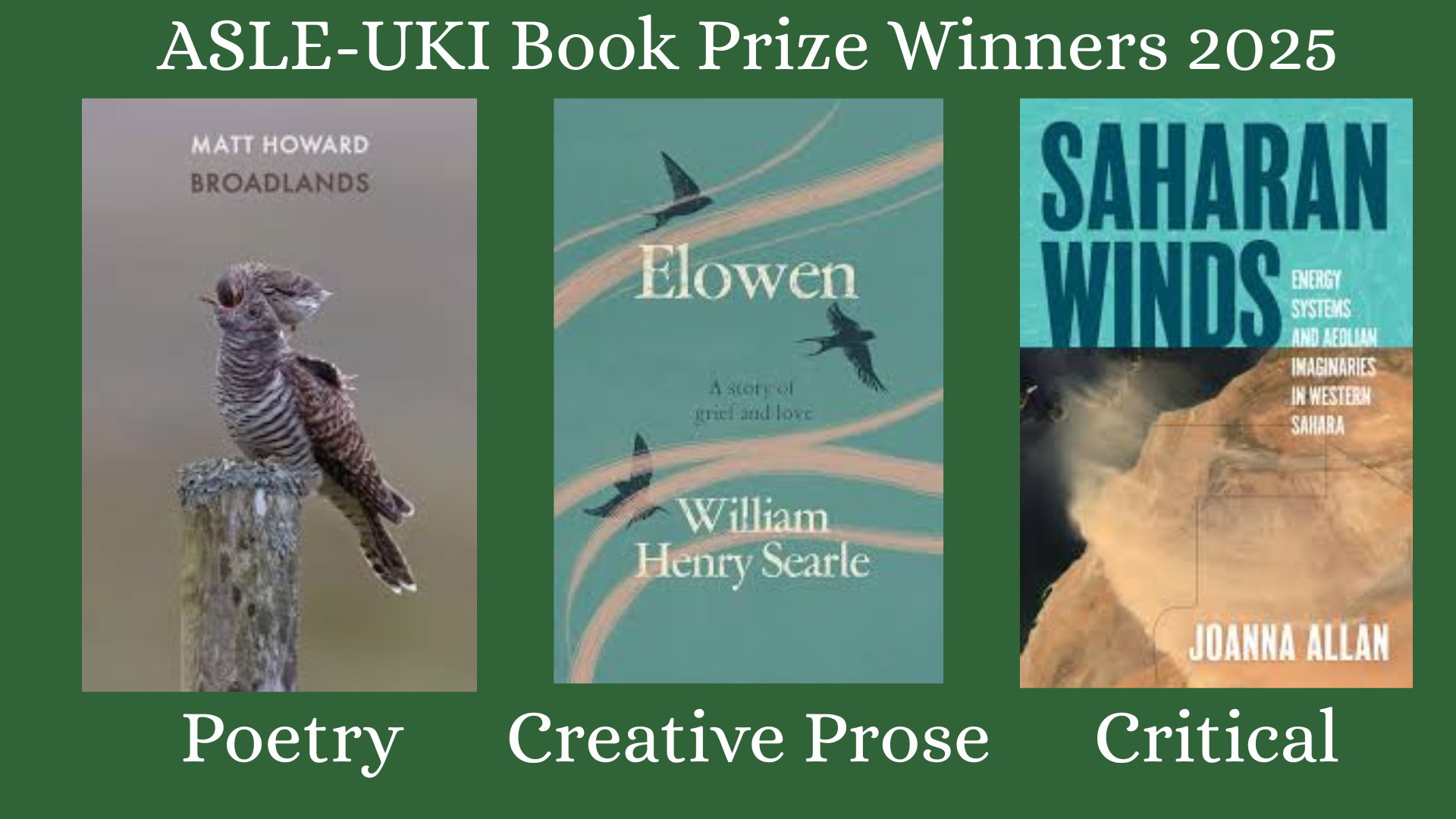
William Henry Searle, Elowen

 
Poetry:
 

Yvonne Reddick, Burning Season
Matt Howard, Broadlands
Steve Ely, Eely
Carol Watts, Mimic Pond

 
Critical:
 

Maria Sledmere, Midsummer Song
Guy Shrubsole, The Lie of the Land
Joanna Allan, Saharan Winds
Enaiê Mairê Azambuja, The Zen of Ecopoetics
Brycchan Carey, The Unnatural Trade
Louis Kirk McAuley, The Ecology of British and American Empire Writing